
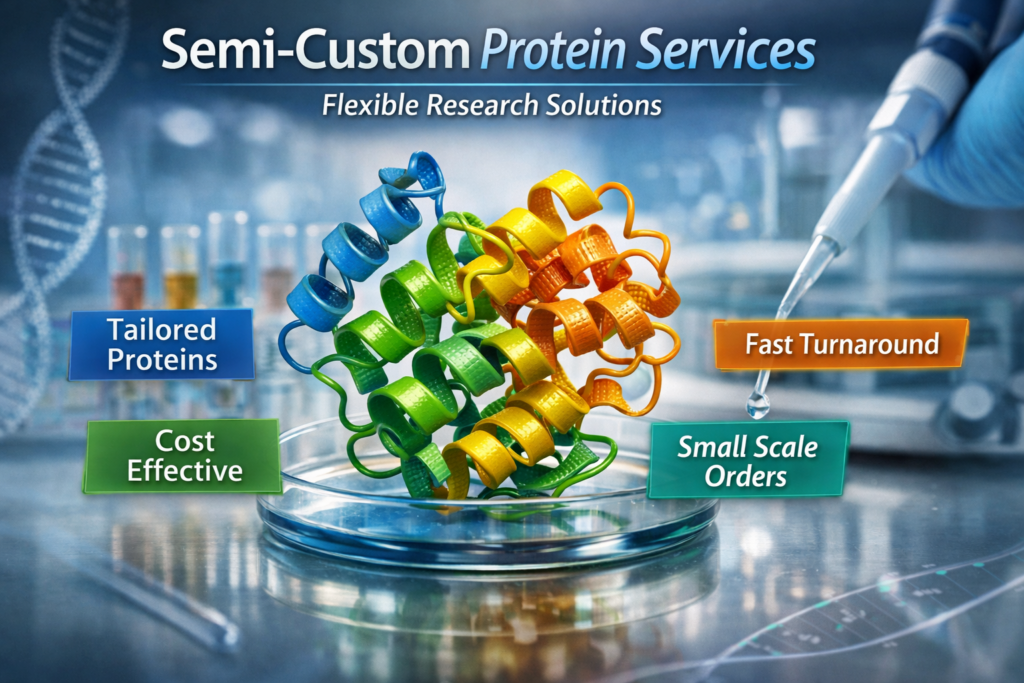
Have you ever run into a roadblock in your lab work because you needed a specific protein but couldn’t find the right fit? Semi custom protein services offer a smart way to bridge that gap without starting from scratch. These options let you pick from a huge range of proteins and tweak them just enough to match your needs, saving time and money in the process.
In today’s fast-paced world of biology and drug development, researchers often look for ways to speed up their projects. Semi custom protein services provide that boost by combining ready-made elements with personal touches. This means you get high-quality proteins quickly, ready for your experiments or tests.
Whether you’re working on new drugs or basic science questions, having access to reliable protein sources changes the game. With semi-custom choices, you can focus more on your discoveries and less on production headaches. Let’s dive into what makes these services a great pick for modern labs.
What Are Semi-Custom Protein Services?
Semi custom protein services sit between standard catalog items and fully built-from-the-ground-up options. They start with a vast library of proteins from different species, like humans, mice, or even plants. You can then adjust things like the protein’s tag or how it’s made to fit your project better.
This setup works well for labs that need small amounts, say 50 micrograms up to a milligram. It’s not about inventing a brand-new protein each time. Instead, it’s using proven methods to produce what you want without long waits.
Many companies now offer these services, drawing from databases with over 300,000 protein targets. This broad selection covers enzymes, antibodies, and more. Researchers in fields like cancer studies or vaccine development find this especially useful.
The Benefits of Semi-Custom Protein Services
One big plus is the cost savings. Full custom work can get expensive due to all the steps involved. Semi-custom cuts those costs by reusing established production lines.
Speed is another key advantage. You might get your protein in weeks rather than months. This keeps your research moving forward without delays.
Flexibility stands out too. Need a His-tag or a fluorescent marker? No problem. These services let you make those changes easily, ensuring the protein works in your assays or models.
- Lower prices compared to complete custom builds
- Faster turnaround times for urgent projects
- Access to a wide variety of protein types and sources
- Options for small-scale orders, perfect for testing ideas
Quality doesn’t take a hit either. Providers use strict checks to make sure proteins are pure and active. This reliability helps you trust the results from your experiments.
How Semi-Custom Protein Services Work?
The process starts with you picking a protein from the library. You describe what you need, like the amount or any modifications. Experts then review your request to confirm it’s doable.
Next comes the production phase. They use systems like bacteria, yeast, or insect cells to grow the protein. This step includes growing cells, extracting the protein, and cleaning it up.
After production, testing ensures everything meets standards. You get reports on purity, concentration, and activity. If something’s off, they fix it before shipping.
For those interested in custom protein production, semi-custom acts as a stepping stone. It uses similar tech but with less setup time. This makes it ideal for initial trials before scaling up.
Applications in Research and Beyond
In drug discovery, semi-custom proteins help screen potential treatments. Researchers use them to test how compounds bind or affect cell functions. This speeds up finding promising leads.
Biotech firms rely on these for developing diagnostics. Custom protein production variants allow creating antigens for tests that detect diseases early.
Academic labs use them for basic studies. Exploring protein interactions or structures becomes easier with quick access to modified versions.
- Drug target validation in pharma pipelines
- Antigen creation for vaccine research
- Enzyme studies in metabolic pathways
- Antibody fragments for imaging tools
Even in agriculture, these services support work on crop improvements. Proteins from plants can be tweaked to study resistance to pests or drought.
Comparing Semi-Custom to Full Custom Protein Production
Full custom protein production involves designing everything from the gene sequence onward. It’s great for unique needs but takes longer and costs more.
Semi-custom, on the other hand, builds on existing templates. This reduces risks and speeds things up. If your project doesn’t require something totally new, semi-custom often wins out.
Think about your goals. For exploratory work, semi-custom provides value without overcommitting resources. As projects advance, you can shift to full custom if needed.
Many users start with semi-custom to test concepts. Positive results then lead to larger custom runs. This step-by-step path minimizes waste and maximizes efficiency.
Getting Started with Semi-Custom Protein Services
Ready to try it? First, list out your protein requirements. What type, quantity, and changes do you need? This helps when contacting providers.
Look for companies with strong track records in protein work. Ask about their libraries and success rates. Good ones offer free consultations to guide you.
Once you submit your order, stay in touch during production. This ensures any issues get sorted quickly.
Tips for success:
- Define your needs clearly from the start
- Check provider expertise in your field
- Plan for how you’ll use the protein in experiments
- Consider future needs for scaling up
With these steps, you’ll integrate semi-custom protein services into your workflow smoothly.
Challenges and Solutions in Protein Production
Not every protein expresses easily. Some are tricky due to folding or stability issues. Semi-custom services often use special hosts to handle these.
For example, insect or mammalian cells work better for complex proteins than simple bacteria. Providers pick the best system based on your target.
Purity can be a concern too. Advanced cleaning methods remove impurities, ensuring over 90% purity in most cases.
By choosing experienced teams, you avoid common pitfalls. Their knowledge turns potential problems into straightforward solutions.
Future Trends in Custom Protein Production
The field is evolving fast. New tech like AI helps predict how proteins will behave during production. This cuts down on trial and error.
Sustainability is gaining focus. Greener methods reduce waste and energy use in labs.
Integration with other services, like gene synthesis, makes the whole process quicker. Expect more one-stop shops for research needs.
These trends make semi-custom even more appealing. They promise better results with less effort.
Why Researchers Choose These Services?
Feedback from users highlights ease of use. No need for in-house equipment or expertise saves labs money.
Consistency is a big draw. Each batch matches the last, supporting reproducible science.
Support teams answer questions promptly, building confidence in the partnership.
In a competitive research landscape, these factors give an edge. They let you focus on innovation rather than logistics.
Conclusion
Semi-custom protein services open doors for researchers seeking flexible, reliable protein sources. By blending catalog options with custom tweaks, they deliver what you need without unnecessary complexity. As the field grows, these services will play a key role in advancing science and medicine.
If you’re facing protein challenges in your work, consider this approach. It could be the solution that propels your projects forward. With benefits like speed, cost savings, and quality, it’s a choice that makes sense for many labs today.