
Garage door openers fail in a small number of recognizable ways. The difficulty is that a couple of those symptoms can also point at a mechanical problem with the door itself, which is a very different and considerably more dangerous situation.
Here are the six faults that account for nearly every opener call, how to tell them apart, and where the line is between homeowner territory and technician territory.
One: Nothing Happens at All
Start with power. Check the opener is plugged in, that the outlet has power, and that the breaker has not tripped. Garage ceiling outlets frequently share a circuit with something else, and a tripped breaker is the single most common cause of a completely dead opener.
If the wall button works but the remotes do not, the problem is the remotes. Replace the batteries, then reprogram them using the learn button on the motor head. If the remotes work but the wall button does not, the fault is the button or its low-voltage wiring, both of which are safe to work on.
If nothing works with power confirmed, the logic board or the motor has failed. That is a service call, and on a unit over twelve or fifteen years old it is usually the point at which replacement makes more sense than repair.
Two: The Motor Runs but the Door Does Not Move
This almost always means the opener has been disconnected from the door, which is exactly what the manual release cord does. Someone pulled it, often during a power outage, and it was never reconnected.
Reconnecting is straightforward on most units with the door fully closed. Depending on the model you either pull the cord back toward the door or run the opener until the trolley re-engages with a click. Check the manual for the specific unit.
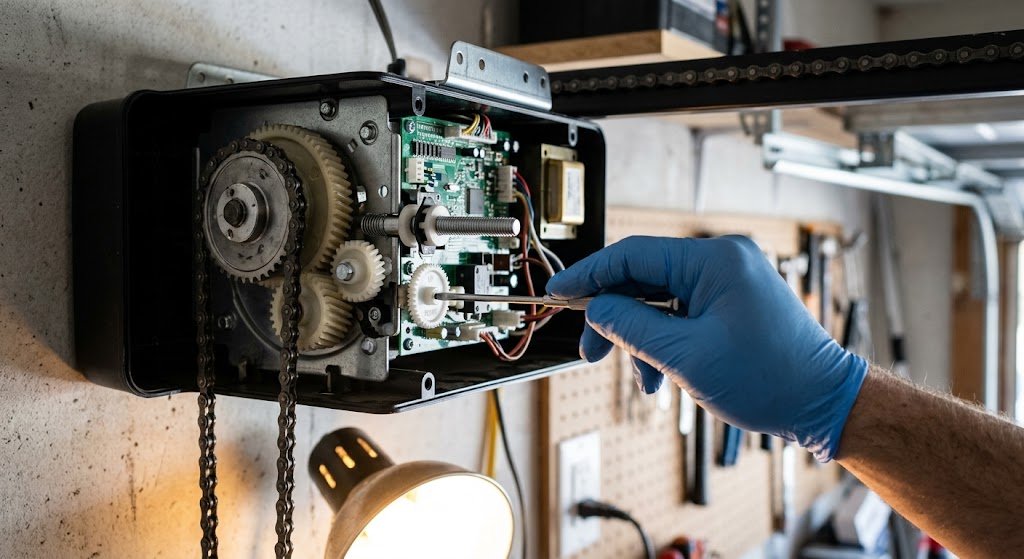
If the trolley is engaged and the motor still runs without moving the door, the drive gear or the trolley carriage has failed. On chain-drive units a stripped nylon gear is common, and it is a repairable fault, but it is inside the motor head.
Three: The Door Reverses Before It Closes
The most common complaint of all, with three possible causes in order of likelihood.
Photo-eye misalignment. The two sensors near the floor must face each other precisely. Most have an indicator light that goes solid when aligned and blinks when it is not. Adjust the brackets by hand until both are solid, and clean the lenses. Direct afternoon sun on a lens can also trigger this, which is why the fault sometimes appears only at certain times of day.
An obstruction in the beam path, which includes a leaning broom, a bin, or a heavy cobweb.
Close force set too low. Adjustable on the motor head, but increase in very small increments and retest the auto-reverse with a block of wood every single time.
Four: The Door Reverses After Touching the Floor
Different symptoms, different causes. This is a travel limit problem, not a force problem. The opener thinks the closed position is slightly lower than it actually is, so it registers the floor as an obstruction.
The down travel limit is adjustable on every opener, usually with a dial or a button sequence on the motor head. Adjust it so the door stops with the bottom seal just compressed against the floor, not driving into it.
Five: The Door Is Heavy, Slow, or Struggling
Stop here. This is the symptom people misread most often and the misreading is expensive.
The opener does not lift the door. The springs do. The opener only guides a counterbalanced door along its tracks. If the door has become heavy or slow, the springs have weakened, and the opener has been compensating by drawing more current and working harder than it was designed to.
Test it safely: close the door, pull the manual release, and lift by hand. A balanced door feels heavy but manageable and stays roughly in place at waist height. A door that will not lift, that shoots up, or that slams down is unbalanced.
Turning up the force setting to compensate is the worst available response. It masks the symptom, burns out the motor, and removes the safety margin the force setting exists to provide. Book garage door opener repair and have the whole assembly assessed, because in this scenario the opener is almost never the actual fault.
Six: Noise
Noise is diagnostic if you know the vocabulary.
Rhythmic grinding or clacking during travel is a roller that has stopped rotating and is dragging in the track. A general rattle is loose hardware, and the hinges and track brackets are worth a wrench check. A grinding from inside the motor head with no door movement is the drive gear. A hum with no movement is a capacitor or motor fault. And a single loud bang followed by a door that will not lift is a broken spring, which is a stop-and-call situation.
The Line
Everything above the door opening is off limits: torsion springs, cables, drums and the shaft. This is not about skill. A torsion spring stores an enormous amount of energy, the job requires specific winding bars and training, and the failure mode when it goes wrong is sudden and severe.
Everything else, the opener unit, remotes, wall button, sensors, settings and general lubrication, is fair game.
The Maintenance That Prevents Most of It
Twice a year: lubricate rollers, hinges and bearings with proper garage door lubricant, tighten the visible hardware, test the auto-reverse with a block of wood, break the sensor beam to confirm it reverses, wipe the sensor lenses, and look at the cables for fraying without touching them.
Fifteen minutes, twice a year, prevents most of the six faults above.